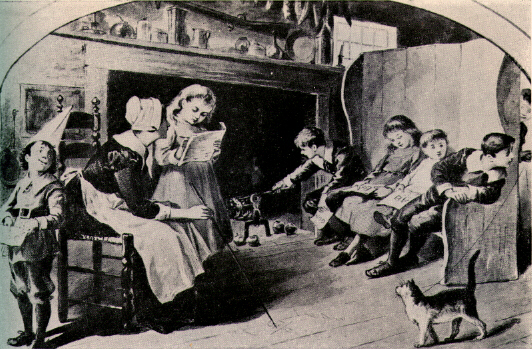
Many students the Renaissance assume the worst for women of the period: unequal rights, inability to inherit, lower social status, and virtually uneducated. While these obviously stem from truth, there were many exceptions to the "rule," and not just in the noble and upper classes either. John Crawford, author of
The Learning, Wit, and Wisdom of Shakespeare's Renaissance Women, observes that for many women of the middle-classes, literacy was a necessity. He writes,
A gentlewoman was supposed to read the Bible and conduct family worship in the absence of the father. A good housewife had to consult the almanacs for proper bloodletting time; to discover in the herbal handbook the best medicine for specific illnesses; cookbooks and sewing books were available. (6)
If women didn't have the skill to read, it often limited her abilities to perform her household duties. Therefore, girls (although not allowed at universities and local grammar schools) were instructed by their mothers in a manner similar to the boys. This instruction included religion, morals, manners, speech, and reading. Girls' educations were furthered by instruction in the economy of a household, food preparation, and organization. Also, observes Crawford, "Knowledge of herbs, often thought of as medicine, was sometimes associated with the women of the Middle Ages" (7). This was partially examined in an earlier
post, describing Ophelia's madness in
Hamlet and how her knowledge of plant life gave a significantly different meaning to the scene.
Besides the existing opportunities for female education during the Renaissance, there were also many writers,
male writers, who advocated education for women. In Thomas More's
Utopia, the author allows "the education of women on a equal basis with that of men," while Sir Thomas Elyot's
The Defense of Good Women supports "the wise training of women in letters and in moral philosophy" (Crawford 10).
Thus we see the undeniable connection between Shakespeare and his educated, female audience. By the end of the sixteenth century, "the feminine audience had reached such proportions that many authors were making a definite and frank appeal to women" (Crawford 13). Not only did women make up a large percentage of the playwright's audiences (as discussed
here), but by establishing that the women were literate and intellectually trained, it can be assumed that Shakespeare acknowledged, even respected, the minds and opinions of his women viewers, and wrote plays and characters that would appeal to their senses as well as the men's.
Works Cited
John Crawford. The Learning, Wit, and Wisdom of Shakespeare's Renaissance Women. Lewiston: The Edwin Mellen Press, 1997.