Pages

Wednesday, March 16, 2011

Elizabethan women: smarter than you think

Many students the Renaissance assume the worst for women of the period: unequal rights, inability to inherit, lower social status, and virtually uneducated. While these obviously stem from truth, there were many exceptions to the "rule," and not just in the noble and upper classes either. John Crawford, author of The Learning, Wit, and Wisdom of Shakespeare's Renaissance Women, observes that for many women of the middle-classes, literacy was a necessity. He writes,
A gentlewoman was supposed to read the Bible and conduct family worship in the absence of the father. A good housewife had to consult the almanacs for proper bloodletting time; to discover in the herbal handbook the best medicine for specific illnesses; cookbooks and sewing books were available. (6)
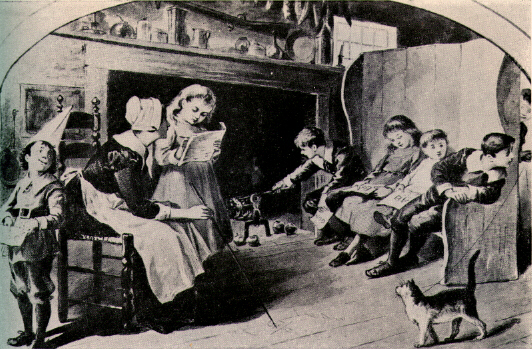
If women didn't have the skill to read, it often limited her abilities to perform her household duties. Therefore, girls (although not allowed at universities and local grammar schools) were instructed by their mothers in a manner similar to the boys. This instruction included religion, morals, manners, speech, and reading. Girls' educations were furthered by instruction in the economy of a household, food preparation, and organization. Also, observes Crawford, "Knowledge of herbs, often thought of as medicine, was sometimes associated with the women of the Middle Ages" (7). This was partially examined in an earlier post, describing Ophelia's madness in Hamlet and how her knowledge of plant life gave a significantly different meaning to the scene.

Besides the existing opportunities for female education during the Renaissance, there were also many writers, male writers, who advocated education for women. In Thomas More's Utopia, the author allows "the education of women on a equal basis with that of men," while Sir Thomas Elyot's The Defense of Good Women supports "the wise training of women in letters and in moral philosophy" (Crawford 10).

Thus we see the undeniable connection between Shakespeare and his educated, female audience. By the end of the sixteenth century, "the feminine audience had reached such proportions that many authors were making a definite and frank appeal to women" (Crawford 13). Not only did women make up a large percentage of the playwright's audiences (as discussed here), but by establishing that the women were literate and intellectually trained, it can be assumed that Shakespeare acknowledged, even respected, the minds and opinions of his women viewers, and wrote plays and characters that would appeal to their senses as well as the men's.

Works Cited

John Crawford. The Learning, Wit, and Wisdom of Shakespeare's Renaissance Women.  Lewiston: The Edwin Mellen Press, 1997. 

Tuesday, March 15, 2011

The Globe Theater: an 11-year-old's view

As a slight tangent from my current topic of Shakespeare's feminine audience, I wanted to share these photos from my trip to London in 2001. When I was younger, I was part of a violin group that traveled abroad and that year we went to England. As part of our stay in London, we toured Shakespeare's Globe Theater, which I remember as an 11-year-old as boring and a waste of time. Now, however, I wish that I'd been able to appreciate the unique experience that I had. We unfortunately weren't able to see a performance there, but the tour was still interesting and I have some great photos to show how Shakespeare's plays must have been seen from an Elizabethan audience.

I know some of our classmates have taken their own looks at the Globe (like Laura), but I thought it would be fun to share my own personal experience with the restored theater.

Entering the Globe's lower gallery (that's my mom in the black and white)

Thursday, March 10, 2011

Shakespeare's feminine audience

Continuing with my overall focus on women in Shakespeare, this post will carry on the discussion I began with my introduction to women as audience members in Elizabethan England. By showing that the female audience was substantial and had significant financial and societal power, I hope to prove that Shakespeare was influenced to write strong, witty, and often powerful female characters.

First, it is important to note the fact that many playhouses and playgroups had women patrons. Phyllis Rackin observes that "the offstage presence of women would have exerted a powerful influence upon playscripts." She gives such examples as the Queen's Men, under the patronage of Queen Elizabeth,


as well as during the reign of the Stuarts, when "Queen Anne, Lady Elizabeth, and Queen Henrietta all issued patents to the companies that took their names" (46). It seems obvious that if a business venture is being supported by a powerful women, the playwright would take care not to offend their patron by writing disagreeable female characters.


Queen Anne
Lady Elizabeth
Queen Henrietta
Continuing from economic point of view, scholarship has shown that women often made up a large part of a playhouse's audience. Rackin comments on this, writing that "players derived the bulk of their income from public performances" and that they "would have been influenced by the fact that women constituted a sizeable proportion of the paying customers in the public playhouses, perhaps more that half" (46). Again, if a playhouse wanted success, it was a simple matter of catering to their consumers. Although women weren't directly involved in the writing or performing of a play, one can still see their influence on Shakespeare's characters because of their attendance and financial power. Seeing it from this business stance, Richard Levin proposes a similar idea (in his article "Women in the Renaissance Theatre Audience), that although "women were not represented at the production end of this industry, they certainly were at the consumption end, and so probably had some effect upon its products" (174).

One last note: it is clear that there were women of all different levels of society in attendance at the playhouses. That being said, it shouldn't be much of a surprise that while many of Shakespeare's more suggestive lines may make us blush, it would have been something enjoyed by his audience, including women. In fact, according to John Crawford, "writers like Robert Anton and John Davies suggest in their work that women of the time loved bawdy verse, especially verse like Shakespeare's Venus and Adonis, and even wrote such verse themselves" (9). Obviously referring to poetry, it is not a stretch to believe the same could be said of Shakespeare's bawdy humor within his plays. Thus we see that women, instead of being embarrassed or even turned away from the playhouses for including such language, were probably the ones most enjoying it. This idea shows that research striving to prove that women did not attend or even like Shakespeare's work because of his sexual humor is false.

Works Cited

Rackin, Phyllis. Shakespeare and Women. New York: Oxford University Press, 2005. 
Levin, Richard. "Women in the Renaissance Theater Audience." Shakespeare Quarterly. 40.2 (1989): 165-174.
John Crawford. The Learning, Wit, and Wisdom of Shakespeare's Renaissance Women.  Lewiston: The Edwin Mellen Press, 1997. 

Tuesday, March 8, 2011

Mapping my project


I was inspired after seeing Jessica's post outlining what she wanted to accomplish for the rest of the semester. She used the learning outcomes to decide what she needed more work on, and to decide on the goals she wanted to achieve. I'm going to do it a little simpler and just give myself a basic outline for how I want my research project to go. I'm hoping this will give me a little more structure as I continue posting, so that I won't get lost in the sea of blogging.

I'm going to approach my research topic, Women in Shakespeare, from a few different angles. First, I'd like to concentrate on the historical background, including women as part of Shakespeare's audience and women's education in Elizabethan England. Next I will be researching Shakespeare's experiences with women in his life, such as his mother, wife, extended family, and Queen Elizabeth herself. I will hopefully finish up the semester by analyzing a variety of plays and characters with strong female roles to demonstrate that Shakespeare was influenced by all these different factors, and could be classified as a proto-feminist. Here is my tentative schedule for following this plan:

March 6-12: Women as audience

March 13-19: Women's education

March 20-26: Research on Shakespeare's female relationships

March 27-April 9: Analysis of Plays and Characters

April 9- End of class: Shakespeare as a proto-feminist

Besides these more formal approaches, I will also be including a few informal posts to help fulfill the other learning requirements. I plan to share different digital mediations of Shakespeare that I've come across, do my own creative imitation of the Bard's work, and do some close textual readings.

I know it's not incredibly specific, but I've learned its nice to have wiggle room when it comes to research blogging. Ideas tend to change and plans need adjustment, so I'm trying not to close any doors on myself.

One thing I'm hoping to get feedback on is advice about which female characters and plays to focus on for the second half of my research. There are so many plays I haven't read where I know there are wonderfully witty and even powerful women, so if you have any suggestions, please let me know! They don't even have to be major characters, just ones who show a break from the stereotypical obedient and dutiful woman. So far on my list I am considering Katharina, Titania (although I haven't read A Mid-Summer Night's Dream, so help on that would be great too), Lady Macbeth, King's Lear's daughters, and possibly Ariel and Miranda from The Tempest.

I'd appreciate any pointers, thanks!

Sunday, March 6, 2011

Flash mobbing is so much fun!

I never thought I would be the type to do it, but being a part of the flash mob performing Romeo and Juliet was a blast! I've always liked performance-type things (I've been in choir, violin groups, plays), but nothing like this before. It was so different than the normal. Although I still had to memorize lines, it was more stressful to remember because I knew people would possibly be looking at me like I was a crazy person. Also, although we practiced enough to get the hang of it, you simply cannot practice a flash mob in the actual setting, so it was a bit of an adventure improvising.

All in all, although it was NOT the way Shakespeare would have performed it (on a stage with every detail worked out and not at a mall with a surprise audience) it was really a fun way to share the Bard's words with the people around us. Although some people still might think we're crazy (ahem, my husband), I really enjoyed performing and would not shy away from doing this again. Kudos to Max and Whitney for putting it on, they did a great job!

Thursday, March 3, 2011

Women as audience members

As students studying Shakespeare, we all know that one of the reasons his plays are so long-lasting was his ability to appeal to many different types of people, including women. It is easy to forget that women made up a significant part of Shakespeare's audience. We often focus on how the women's roles were played by men or how the bawdy and racy humor alluded mainly to male viewership. However, several scholars have studied how Shakespeare's plays may have been attended by many women, all from all different classes and distinctions.

The first is Phyllis Rackin, who I've quoted in a previous post. Like I mentioned before, Rackin discusses how in order to make a profit "even the private playhouses catered to women as well as men" and that "they included applewives and fishwives, doxies and respectable citizens, queens and great ladies" (24-25). She also concludes that "because playing was a commercial enterprise, it was in the players' interests to please as many of the paying customers as they could, the women no less than the men" (25). It is my deduction that if a woman was not "pleased" by a play, she would not be a repeat customer. This meant that the playhouse also lost the business of her husband and household, as well as those whom she may have told about the play. A wise business decision would then be to simply make the customer happy.

The second scholar who has researched the idea of women as audience is Richard Levin in his article "Women in the Renaissance Theatre Audience." He quotes three different passages from Shakespeare's plays in order to assert that he "was aware of women as a distinct component of his audience that he had to please" (168). Here's one example from Henry IV:
All the gentlewomen here have forgiven me; if the gentlemen will not, then the gentlemen do not agree with the gentlewomen, which was never seen in such an assembly.
This quote not only shows the power that women had over the opinions of men (at least in the context of a playhouse) but that Shakespeare recognized women's financial power as well.

I will continue this train of thought in my next post, but I hope this gives a good idea of what I'm aiming for in my research. I'll be holding off on thematic and character analysis until I've established some historical and cultural background to base my ideas on, so the next few post will be more about Shakespeare's audience as well as the women in his life.

Works Cited
Rackin, Phyllis. Shakespeare and Women. New York: Oxford University Press, 2005.
Levin, Richard. "Women in the Renaissance Theater Audience." Shakespeare Quarterly. 40.2 (1989): 165-174.

Tuesday, March 1, 2011

Women on trial

As I was reading the scene from The Winter's Tale, I couldn't help but feel that Hermione was a type for all women of Shakespeare's day. Women were often seen throughout history as the originators of sin, because of Eve. It is very common to read about women as objects of desire, as disobedient wives and daughters, and even as witches. This makes Leontes' irrationality almost make sense: he's simply responding to centuries of prejudice against women. Obviously, we can't entirely excuse his tyrannical and jealous behavior, but I feel tradition gives him a reason to suspect his wife. Part of the fault lies with society.

Hermione, the perfect picture of innocence, chastity, and obedience, is representative of how women were expected to be. In the trial, however, she is made out to be exactly the opposite. Leontes falsely accuses her of treason and adultery, something the audience knows she is innocent of. In general, I believe that this scene perhaps demonstrates that women have been conceived of unfairly in history and in Shakespeare's day, and Hermione's and Paulina's lines give women the voice that they have been forbidden them for centuries. This is particularly interesting since eventually it is proven that Hermione is innocent, showing her true fidelity and obedience to the king.


Paulina's character was also very important to this scene, I believe. Once Hermione has died, there must be someone to defend the cause of women, and so Paulina rebukes the king for his actions (listing the people that have died or suffered because of him), and her speech includes some of the most powerful lines of the scene:
But, O thou tyrant!
Do not repent these things, for they are heavier
Than all thy woes can stir. Therefore betake thee
To nothing but despair. A thousand knees
Ten thousand years together, naked, fasting
Upon a barren mountain, and still winter
In storm perpetual, could not move the gods
To look that way thou wert.
Paulina tells it like it is, and receives no punishment for speaking her mind. She is told to be silent by a member of the court, and she herself immediately apologizes for the outburst, but no other punishment is inflicted. I feel that Paulina's speech and her sudden silence are also examples of how women's voices have been oppressed throughout history. She told nothing but the truth, something the king acknowledges when he states that "Thou didst speak but well When most the truth." However, although both she and Hermione spoke well, they were also eventually silenced.

What does this mean coming from a feminist standpoint? Hermione and Paulina are women who are oppressed despite their truthfulness, (Hermione by death and Paulina by the Lord) who are eventually recognized as honorable and steadfast. Shakespeare undoubtedly wrote many strong female characters that exhibit feminist qualities, but this is an example of plot that supports women in general as being true, constant, and loyal.