I'm going to start with some disclaimers about my thesis. My basic argument is that because of the influence of his female audience, patrons, and personal relationships with women, Shakespeare wrote female characters that were independent, intelligent, and strong. I will even go so far as to suggest he was a proto-feminist, since he recognized the worth of the female mind. I know there are some objections to this idea, which I will address here.
As brought up by Chris Welcker in a comment to one of my previous posts, Shakespeare wasn't always respectful to women. This can be seen in the case of his wife, Anne Hathaway. Anne (although not a complete pushover, as I discussed here) was apparently not an overly critical part of Shakespeare's life. There are few remaining records of her activity in Stratford, and none at all to suggest she had anything to do with her husband's business dealings at the theater. Phyllis Rackin thinks part of this may have to with Shakespeare's lack of trust and confidence in his wife. She states: "A possibility is that William did not trust Anne to manage the family property. Her absence from the legal records of all William's financial affairs might mean that Anne had an exceptionally passive role in the economic affairs of the Shakespeare family" (39).
So although I admit that there is evidence for the idea that Shakespeare wasn't respectful to all women, there is also substantial proof that despite this, he was still influenced by the many women in his life. Whether he truly admired them or simply wrote the female characters for financial gain is something that cannot be known for sure.
Now that I've shared some opposing views to my thesis, I can approach my topic from a textual standpoint by analyzing the female characters in Shakespeare's plays. I've previously discussed Portia and Paulina, along with Miranda, as good examples of intelligent female characters. For this post, I've chosen two main characters from different plays to help prove my thesis.
Showing posts with label Gain Shakespeare Literacy. Show all posts
Showing posts with label Gain Shakespeare Literacy. Show all posts
Sunday, April 3, 2011

Friday, February 11, 2011
Comparing "Lears"
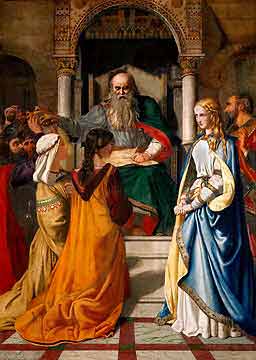
Similarities
The basic plot. Both stories contain the same basic plot. Lear tests his three daughters on their individual declarations of love for him, Cordelia is sent to France, and Goneril and Regan eventually take power with their husbands.
The main characters. King Lear, along with his three daughters and their husbands, all remain relatively true to the original source. Lear is portrayed in both as the doting father with a temper, Cordelia as the innocent one, and Goneril and Regan and their husbands as the schemers and liars.
Dialogue. There are several specific scenes that are similar between the two texts. The original is much shorter, but still includes some dialogue that is very similar to Shakespeare's lines. One example is Cordelia's accounting of her love for Lear. Here is the original: "You truly have have as much of my love as you are worth: that's how much I love you." And here is Shakespeare's: "I love Your Majesty according to my bond, no more nor less." Not identical, obviously, but enough to make a connection.
Differences (there are a LOT more)
New plot lines. There is quite a bit more action and dialogue going on in Shakespeare's Lear than in Geoffrey of Monmouth's "A History." There is the whole business with Gloucester and his sons Edmund and Edgar, Kent in disguise, and the fighting over Edmund by both Goneril and Regan that was not in the original story. My reasoning for this is that Shakespeare had to add things to make the play long enough for performance, since the original text is only a few paragraphs long.
Minor characters. Shakespeare adds an assortment of new characters to the story. Kent, Gloucester, Edgar, Edmund, Oswald, the Fool, and the other secondary characters are all new additions. Why did he add so many? Like I said above, it may have been to simply add length to an otherwise short story, but I think it also may have been to give the major characters depth. For example, in the original, it doesn't elaborate much on what kind of king Lear was, or how he was as a person. In the play, by including such characters as the Fool, Kent, and Gloucester, I feel we have a glimpse of what kind of a king Lear must have been. These three men, among others, follow the king with absolute loyalty, even out into a terrible storm just to make sure he's safe. Also, even though his older two daughters despise him, we know that he must have been a decent father, since Cordelia loved and cared for him deeply.
Slight changes to the plot. Throughout the play, Shakespeare made slight adjustments to the original story. There are several examples of this. First of all, in the historical account, the king of France is not actually present during the first scene where Lear awards his lands to his daughters. He is still in France and only hearing of Cordelia's beauty is enough for the marriage to take place. He claims that "he had gold and silver and lands enough." Interesting that the only daughter to be disowned by her father is also the only one to marry for love.
Another change made was how Goneril and Regan took control. In the play, it was immediate: the power was granted to them by their father. In the source, however, it's very clear that it really happened much slower. When Cordelia is sent to France, it states that "after a long space of time, old age began to wear Lear down, and the dukes to whom he had partitioned the kingdom and married his daughters rose up against him. They seized from him the kingdom and the sovereign power that he had hitherto wielded bravely and gloriously." So in the original, the sons-in-law actually forcefully took Lear's power while Shakespeare gives a much more peaceful transition.
One more major change is obviously the ending. Since we know that it is a Shakespearean tragedy, people have to die at the end. After the battle between Lear and his two daughters, almost everyone (including Lear and his three daughter) ends up dead in a sad twist of fate. In the original version, however, the ending was much happier. Lear's and Cordelia's forces defeated those of Goneril's and Regan's, and Lear lived for three years after regaining his power. After his death, it states that "Cordelia assumed the governance of the kingdom." Much less sad, yes? I'm curious, however, why Shakespeare didn't have Cordelia end up alive and in control of the country. Coming from the time of Elizabeth, you would think he'd be open to the idea of a woman ruler. Anyone have any ideas on that?
After reading both texts, my conclusion is that Shakespeare was not a plagiarist. He simply took a basic idea and story, one that was probably already well-known in England, and made it his own. He added so much to make it unique that the differences definitely outweighed the similarities between the two stories.
Saturday, February 5, 2011
Film Review of "Taming of the Shrew"

Although so far in this class I've watched the film productions after finishing reading each play, I decided to try something different for The Taming of the Shrew. This was mostly because after the generally direct language of Hamlet and Henry V, this comedy had so many innuendos and references that it took me nearly twice as long to get through a page. After reading through Act 3, I decided to watch the film production so I could get a better grasp on the humor and plot as I finished the play.
I watched the 1960's version of The Taming of the Shrew with Elizabeth Taylor and Richard Burton. I must say I had some doubts about it, since it's an older film, but I'm going to start by stating how much I LOVED it! I thought they did a fantastic job with casting, and loved Taylor's and Burton's take on Katharina and Petruchio. The costumes and sets were great, and the story was easy to follow. I'm going to break my review down into three categories: things that were changed in the film, my personal reaction, and how it helped me understand the play better.
First off, although you obviously have to cut some things when doing a Shakespeare production for a general audience, I found it interesting that the "play within a play" starring Christopher Sly was cut from the film. I thought that it was a very funny part of the play, but I guess I can understand how it may confuse modern viewers. Second, besides cutting lines, they also changed some words (such as "mew" to "lock), in an obvious effort to reach a broader audience. Third, there was a lot more action than I thought there would be, which I really enjoyed (especially Kate's and Petruchio's first conversation, gotta love it!).
I've already made it clear that I loved the film, and here are just some of the things that stood out to me:
1. Kate is kind of crazy!
2. Petruchio is kind of crazy! (really makes you think of Bianca's line: "That, being mad herself, she's madly mated.")
3. Hortensio's wig is rather ridiculous. Not even the one he uses as disguise, but the one he wears throughout the movie.
4. Marriage has changed so much since Shakespeare's time!
5. I love Kate and Petruchio's interactions. I feel like everything they say and do is a test for each other.
And lastly, I'd like to discuss how the movie helped me understand the play better, and even changed my mind about a few things. First, in the movie (like I said above) Kate is truly crazy! While reading the play, I felt so sympathetic for Kate thinking that her father didn't love her and everyone thought she was a "fiend." In watching the film, however, my sympathies definitely were with Baptista and Bianca, because Katharina was awful! She was beating on Bianca, rude to her father, and breaking everything in sight. But then, of course, my sympathies switched back to Kate when Petruchio is late to the wedding, and then withholds food and generally makes her miserable.
Really, Kate was easily the most fascinating character to me. Everyone else is designed by some goal they want to achieve: Petruchio wants money, Baptista to marry off his daughters, and Gremio, Hortensio, and Lucentio want to marry Bianca. But what Kate wants is never really clear. Why does she act the way she does? Why does she marry Petruchio? And why does she allow herself to be "tamed" at the end of the movie?
I felt that the film gave me an insiders look into Katharina. I am now on the side of those who claim that she was never really tamed, but just went along with it in order to work the system. She knew if she remained unmarried she would have to live with her father forever, something I'm sure didn't appeal to her. Then, when Petruchio treats her terribly in his home, she learns to agree with what he says in order to get the things she wants. This wasn't terribly explicit in the play, but the film definitely gave that impression with all of Kate's sarcastic tones and side-long glances. In the end, she was a rich, well-dressed, and respected woman, which I think may have been her desire all along, and she achieved that only by allowing herself to be tamed. What do you all think? Which side are you on?
My schedule for King Lear:
2/07 - Read Background and Act 1
2/09 - Read Acts 2 and 3
2/11 - Read Acts 4 and 5
Wednesday, February 2, 2011
My experience with AskShakespeare
Like we tried out in class, I posed my own question to the experts over at AskShakeapeare, and these are my results. Here are some of the people who responded:
Almasi Zsolt – @zsalmasi – reader at Péter Pázmány Catholic University, Hungary, interested in Tudor literature, and histories
Actors Shakespeare Company – @ActorsShakes – artistic director, Colette Rice of the theatre in residence at New Jersey City University
Shakespeare’s School – @ShakespearesSch – for all things related to Shakespeare’s School days
It was fun being able to chat with people I knew were knowledgeable about Shakespeare, and got some interesting responses and some great links, so check them out!
My Question:
JoannaLance: I know Shakespeare used a lot of English History in his plays. Did he also use elements of his personal life? #askshakespeare
My Answers:
BarbotRobot: @JoannaLance #askshakespeare His son, who died very young, was named Hamnet
zsalmasi: @JoannaLance Surely, but it is rather difficult to tell with precision. I reckon references to the theater are the ones. #askshakespeare
ActorsShakes: @JoannaLance #AskShakespeare That is a huge and loaded question. We just don't know. We can conjecture, but we are only guessing.
ShakespearesSch: #AskShakespeare @JoannaLance . . & some believe 'Seven ages of Man' speech inspired by these buildings http://bit.ly/bu_guild
I also enjoyed other questions and answers:
todayilike: #askshakespeare my Mum asks Shakespeare, What do you do in your spare time?
ActorsShakes: @todayilike #AskShakespeare - Spare time? I write plays, copy parts, rehearse, learn parts, fights, dances, perform, ride to Stratford...
zsalmasi: @todayilike I like to imagine that Sh did much reading in his spare time, and falconry, perhaps. #askshakespeare
ActorsShakes: @todayilike #AskShakespeare Truly he would have had little spare time. The played 6 days a week, almost always a different play.
Almasi Zsolt – @zsalmasi – reader at Péter Pázmány Catholic University, Hungary, interested in Tudor literature, and histories
Actors Shakespeare Company – @ActorsShakes – artistic director, Colette Rice of the theatre in residence at New Jersey City University
Shakespeare’s School – @ShakespearesSch – for all things related to Shakespeare’s School days
It was fun being able to chat with people I knew were knowledgeable about Shakespeare, and got some interesting responses and some great links, so check them out!
My Question:
JoannaLance: I know Shakespeare used a lot of English History in his plays. Did he also use elements of his personal life? #askshakespeare
My Answers:
BarbotRobot: @JoannaLance #askshakespeare His son, who died very young, was named Hamnet
zsalmasi: @JoannaLance Surely, but it is rather difficult to tell with precision. I reckon references to the theater are the ones. #askshakespeare
ActorsShakes: @JoannaLance #AskShakespeare That is a huge and loaded question. We just don't know. We can conjecture, but we are only guessing.
- JoannaLance: @ActorsShakes What do we know? Any specific facts, like characters he may have based on someone he knew? #askshakespeare
- ActorsShakes: @JoannaLance #AskShakespeare we can't say 'fact.' William Page is a school boy studying Latin in Merry Wives - much like WS must have done.
- JoannaLance: @ActorsShakes So we can probably assume that the kind of school he had was reflected in his character William Page? #askshakespeare
- ActorsShakes: @JoannaLance #AskShakespeare From the scene with William & Hugh Evans (Schoolmaster) it seems this was part of a typical boy's education.
- ActorsShakes: @JoannaLance #AskShakespeare There are the stories that John Falstaff was originally John Oldcastle, named for a historical figure.
- ActorsShakes: @JoannaLance #AskShakespeare WS had twins, one of whom died as a child - Viola and Sebastian are twins who each think the other dead.
ShakespearesSch: #AskShakespeare @JoannaLance . . & some believe 'Seven ages of Man' speech inspired by these buildings http://bit.ly/bu_guild
- JoannaLance: @ShakespearesSch That's really interesting! Thanks for the info #askshakespeare
- ShakespearesSch: #AskShakespeare @JoannaLance @ActorsShakes Sir Huw Evans/my successor Sir Thomas Jenkins http://bit.ly/flickr_PD01 )
- ShakespearesSch: #AskShakespeare @JoannaLance . . . & local inspiration for "Tempest" http://bit.ly/SBT_FS127
- ShakespearesSch: #AskShakespeare @JoannaLance from his schooldays http://bit.ly/flickr_PD01
- ShakespearesSch @JoannaLance @ActorsShakes detailed & scholarly comment from Prof David Crystal http://bit.ly/DC_pwl (pdf file)
- ActorsShakes @ShakespearesSch @JoannaLance #AskShakespeare That's great. It said everything I researched when I directed MWives but can't fit in a Tweet.
- Joanna Lance: @ActorsShakes @ShakespearesSch Thanks to you both! I got some great stuff out of this :) #askshakespeare
I also enjoyed other questions and answers:
todayilike: #askshakespeare my Mum asks Shakespeare, What do you do in your spare time?
ActorsShakes: @todayilike #AskShakespeare - Spare time? I write plays, copy parts, rehearse, learn parts, fights, dances, perform, ride to Stratford...
zsalmasi: @todayilike I like to imagine that Sh did much reading in his spare time, and falconry, perhaps. #askshakespeare
ActorsShakes: @todayilike #AskShakespeare Truly he would have had little spare time. The played 6 days a week, almost always a different play.
There's still time to ask your question! Head on over to twitter or follow the instructions here!
Sunday, January 30, 2011
Tennis balls and other Shakespearean insults
After finishing this history play, I feel that what made reading Henry V so engaging was the different types of language that Shakespeare used. He had the legal and religious jargon of an archbishop, the blood-boiling rhetoric by Henry in the field of battle, and the casual dialects of the lower classes. Across all these different levels of communication, however, the one thing that he always seemed able to convey (whether it be tennis balls or accusations of being a "prick-eared cur of Iceland"), was insults. My favorites are by Pistol: "egregious dog," "viper vile," and "braggart vile." There's also some good exchanges of insults between the French and English, like in Act 1 with the tennis balls, and at the end of Act 2 with this dialogue:
Also, this week we will be starting comedies. I'm reading The Taming of the Shrew, and this is my reading schedule:
01/31 - Background and Act 1
02/02 - Acts 2 and 3
02/04 - Acts 4 and 5
DAUPHIN
For the Dauphin,
I stand here for him. What to him from England?
EXETER
Scorn and defiance, slight regard, contempt,
And anything that may not misbecome
The mighty sender, doth he prize you at.
Thus says my king: an if your father’s Highness
Do not, in grant of all demands at large,
Sweeten the bitter mock you sent his Majesty,
He’ll call you to so hot an answer of it
That caves and womby vaultages of France
Shall chide your trespass and return your mock
In second accent of his ordinance.
DAUPHIN
Say, if my father render fair return,
It is against my will, for I desire
Nothing but odds with England. To that end,
As matching to his youth and vanity,
I did present him with the Paris balls.
EXETER
He’ll make your Paris Louvre shake for it,
Were it the mistress court of mighty Europe.
And be assured you’ll find a difference,
As we his subjects have in wonder found,
Between the promise of his greener days
And these he masters now. Now he weighs time
Even to the utmost grain. That you shall read
In your own losses, if he stay in France.
I don't know if this struck anyone else, but the first thing that came to mind when reading the taunting between the French and English was this scene from Monty Python and the Holy Grail. Enjoy! :)
Also, this week we will be starting comedies. I'm reading The Taming of the Shrew, and this is my reading schedule:
01/31 - Background and Act 1
02/02 - Acts 2 and 3
02/04 - Acts 4 and 5
Sunday, January 23, 2011
One last note on Hamlet

Although our class is moving on to Shakespeare's histories this week, I couldn't resist posting once more about Hamlet. What can I say? It's a great play.
This semester, I am also taking British Medieval Literature (really interesting class, by the way), and it has truly surprised me how many similarities there are between many of my other readings and Hamlet. We've discussed in class how Shakespeare could be considered somewhat of a plagiarist, that much of what Shakespeare wrote was borrowed from early British historians and writers. Well, in Medieval Brit. Lit. there are just tons of examples of this. I picked out just one to share with you.
We have been reading what's called "The Anglo-Saxon Chronicles," a history that summarizes the most important events of each year, written between the 9th and 11th centuries. In one entry, discussing the death of William the Conquerer, it states:
"He that was before a rich king, and lord of many lands, then had no more land than a space of seven feet! and he that was once enshrouded in gold and gems lay there covered with dirt!"To me, this bears a striking resemblance to Hamlet's remarks in the Graveyard scene:
"This fellow might be in ’s time a great buyer of land, with his statutes, his recognizances, his fines, his double vouchers, his recoveries. Is this the fine of his fines and the recovery of his recoveries, to have his fine pate full of fine dirt? Will his vouchers vouch him no more of his purchases, and double ones too, than the length and breadth of a pair of indentures? The very conveyances of his lands will hardly lie in this box, and must the inheritor himself have no more, ha!" (5:1)
Both of these passages relate to the idea of death as the great equalizer, and using remarkably similar examples. Although Hamlet is describing a great landowner instead of a king, both authors express the idea that although someone in life may have had great riches or land, he eventually only end up with "a space of seven feet."
Besides that passage, there is also similar language used between the two texts: "churl" and
"twelfth-night," as well as the name Osric (like the character at the end of Hamlet), although I could be stretching the coincidences with that one.
I thought it was interesting to find such explicit examples of Shakespeare borrowing from other authors. I will be posting more on this subject when we get to reading tragedies, as Geoffrey of Monmouth's "A History of the Kings of Britain," (which I've also read in my other class), contains the account that Shakespeare later draws from to write King Lear, which I think will make for an interesting comparison.
As of right now, my reading schedule for this week is:
01/24- Read historical background and summary for Henry V; read Act 1
01/26- Read Acts 2-3
01/28- Read Acts 4-5
I'm going to take this week by week, as I don't know what my exact plan is and I'd like to be flexible. I'll try to post before every class period, and will hopefully be able to work in some fun creative interpretations and analysis.
Wednesday, January 12, 2011
"To thine own self be true"
This phrase, spoken by Polonius, is possibly the most satirical and ironic idea that Shakespeare included in Hamlet. First of all, it is spoken by the phoniest of all the characters, a councillor to the king who spends most of his time fawning over the royal family and speaking nonsense. Never, throughout the whole play, is he true to his own self. He hides behind his rhetoric, which is ridiculous in and of itself: "Why day is day, night night, and time is time, were nothing but to waste night, day, and time. Therefore, since brevity is the soul of wit, and tediousness the limbs and outward flourishes, I will be brief" (Act 2, Scene 2). Because of his unnecessary and flowery language, Polonius is the complete opposite of what he claims to be, brief and to the point.
Another more physical representation of Polonius being untrue to himself is his tendency to hide behind curtains to eavesdrop. While this habit is strange, childish, and borderline creepy, it also shows his unwillingness to show his true self. He desires to see behind the masks and lies of others, but not at the risk of leaving his self vulnerable.
Besides Polonius, there are many, many other examples of characters not being true to themselves. Hamlet hides his indecision behind a facade of madness. Claudius is obviously guilty of fratricide and incest, but conceals it with his mask of sorrow over his brother's death. And then of course there are the players, whose whole purpose in life is to pretend to be someone they're not.
Although Polonius counsels his son Laertes "To thine own self be true," he does not follow his own advice, and apparently neither does anyone else in the play. This pattern of pretense throughout the play reveals to us Shakespeare's great love of irony, something I'm sure we'll see more often when we move from tragedies to comedies and romances.
Subscribe to:
Posts (Atom)